

As organizations accelerate cloud adoption and hybrid work remains the norm, legacy perimeter defenses are no longer sufficient. Combining Zero Trust Architecture (ZTA) with AI-driven threat intelligence and cloud-native security tools creates a layered, adaptive defense model that reduces risk and speeds response. This post explains how these approaches complement one another and offers practical steps to implement them. cter.
What is Zero Trust Architecture?
Zero Trust is a security model that assumes no actor or system, inside or outside the network. It should be trusted by default. Core principles:- Verify explicitly: continuous identity verification and device posture checks.
- Least privilege access: grant only necessary permissions.
- Assume breach: monitor and minimize blast radius.
The Custom Advantage:
- Faster detection: machine learning models surface suspicious patterns in real time.
- Contextual risk scoring: combine identity, device posture, location, and behavior to drive adaptive access decisions.
- Automated enrichment: correlate indicators of compromise (IOCs) across sources to prioritize remediation.
- Cloud-native posture management (CSPM) to detect misconfigurations
- Cloud workload protection platforms (CWPP) for runtime defense.
- Identity-first approaches since identity is the new perimeter.
- Secure infrastructure as code (IaC) and continuous compliance.
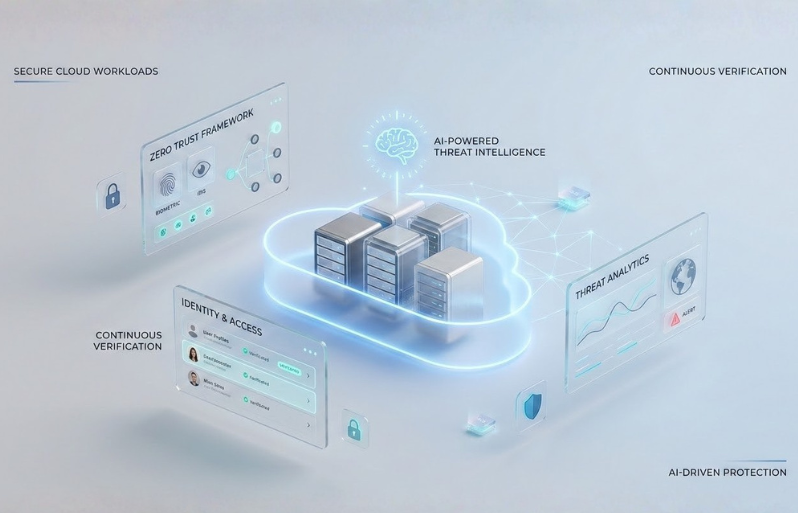
Integrating the Three: Architecture and Flow
- Telemetry collection: aggregate logs and signals from endpoints, identity providers, cloud workloads, and perimeter gateways.
- AI analysis: threat intelligence systems analyze telemetry, correlate indicators, and assign risk scores.
- Policy decision: the ZTA policy engine uses identity + device posture + AI risk score to make allow/deny or step-up decisions.
- Enforcement & automation: enforcement points (CASB, SASE, IAM, micro-segmentation controls) apply actions; SOAR/XDR systems automate containment and remediation.
- Feedback loop: outcomes feed back into the AI models to improve detection and reduce false positives.
Practical Implementation Steps
- Start with identity and access:
- Enforce MFA, conditional access, and single sign-on (SSO).
- Adopt least-privilege roles and Just-In-Time (JIT) access.
- Instrument your environment:
- Centralize logs and metrics from cloud services, endpoints, and networks.
- Deploy endpoint telemetry and EDR/XDR agents where feasible.
- Deploy cloud posture and workload protections:
- Use CSPM for drift and misconfiguration detection.
- Implement CWPP and runtime protection for containers and serverless.
- Introduce AI-driven intelligence:
- Integrate threat feeds and behavioral analytics into your SIEM/XDR.
- Use AI risk scoring to inform access policies.
- Automate response:
- Build playbooks in SOAR for common incidents (credential abuse, lateral movement, data exfiltration).
- Automate containment steps: revoke sessions, isolate workloads, block IPs.
- Micro-segmentation and network controls:
- Use software-defined segmentation in cloud and on-prem workloads.
- Enforce policy at service and application level, not just network level.
- Measure and iterate:
- Track MTTR, number of escalations, access friction, and user experience.
- Tune models to reduce false positives and improve coverage.
Risks and Considerations
- Privacy and bias: AI models must be validated to avoid false positives and discriminatory outcomes.
- Complexity: integrating many tools can create gaps — rely on interoperable standards (OpenID Connect, SCIM, STIX/TAXII).
- Skill gaps: invest in staff training or managed services to accelerate safe deployment.
- Data quality: AI effectiveness depends on high-quality telemetry and labeling.
Quick Checklist for Technical Teams
- IAM: SSO, MFA, conditional access policies
- Telemetry: centralized logging, EDR/XDR, cloud audit logs
- Cloud posture: CSPM, IaC scanning, runtime protection
- Analytics: SIEM with ML/behavioral analytics, threat feeds
- Automation: SOAR playbooks, policy-driven enforcement
- Segmentation: micro-segmentation, service-to-service ACLs
Conclusion Zero Trust, AI-driven threat intelligence, and cloud security are complementary pillars for securing modern enterprises. Zero Trust provides the access framework, cloud security protects dynamic workloads, and AI-driven intelligence supplies context and speed. Together they reduce risk, accelerate detection and response, and enable secure cloud-first strategies — provided organizations instrument data correctly, automate response, and continuously tune their systems.
0 Comments